
3D Rendering vs Photography: Why Rendering Wins for Product Visuals
Why 3D rendering has overtaken traditional product photography for premium brands, and what it changes about cost, iteration, and creative control.
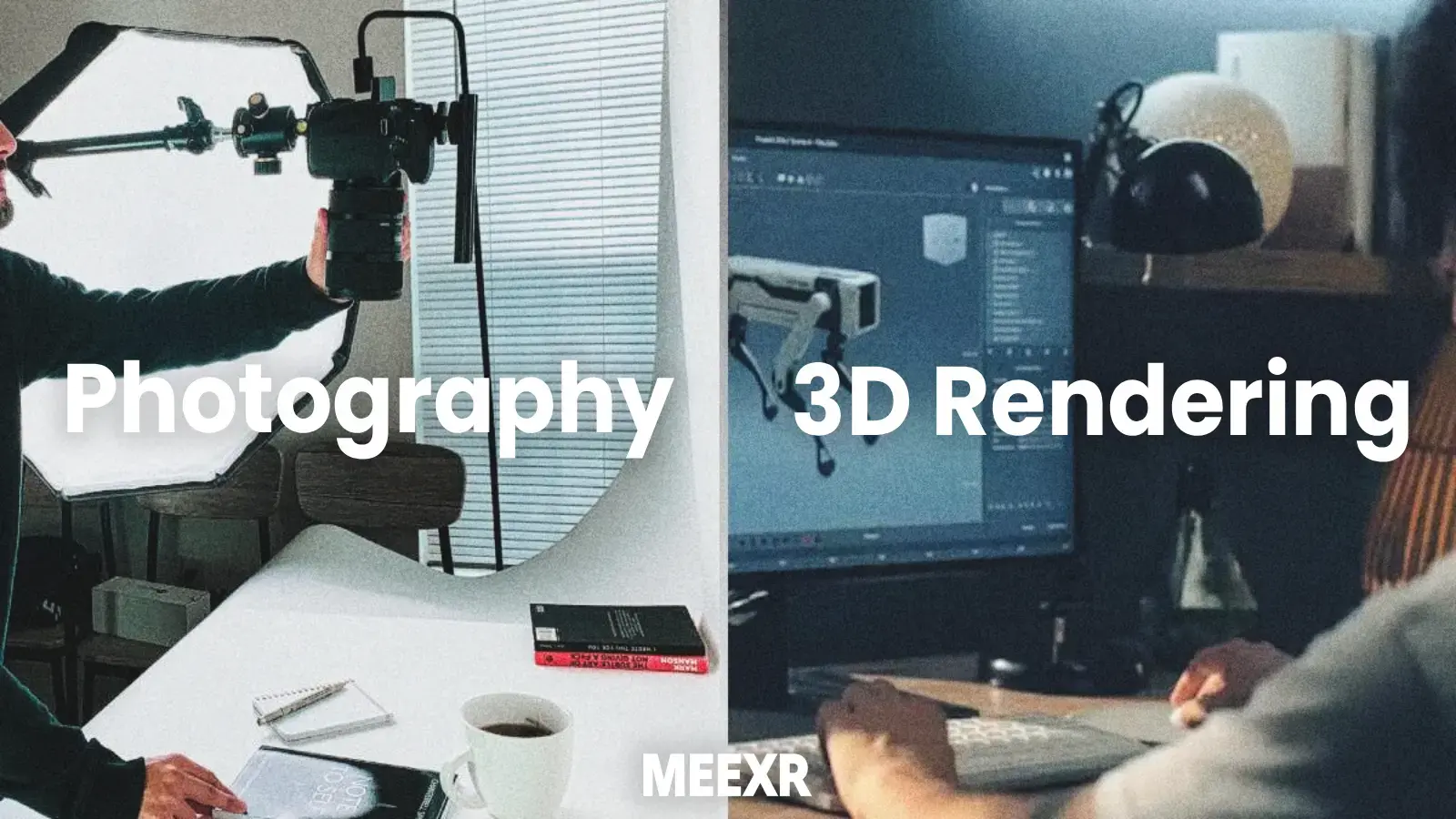
For decades, product photography was the default. Build the prop, light the set, shoot it, retouch it, ship it. We still do it, but for most product visual work we take on at MEEXR, 3D rendering now does the job faster, cheaper, and with more creative range than a camera ever could.
Here's why that shift happened, and where the camera still wins.
What traditional photography actually costs
A polished product shoot looks straightforward from the outside. In practice it's:
- Studio rental, often by the day
- A photographer plus an assistant or two
- Lighting rigs, modifiers, and backdrops
- A physical prototype, sometimes the only one in existence
- Retouching and color work after the fact
- A reshoot if marketing later asks for a different angle, colorway, or background
The fixed costs aren't the problem. The iteration cost is. Every variation (a new color, a new environment, a new camera angle) means rebuilding the set or working it in Photoshop with diminishing returns.
What 3D rendering does instead
Once a product exists as a 3D model, every subsequent image is a render setting. New colorway? Swap a material. New environment? Drop in a different HDRI. Top-down hero shot for the homepage and a 3/4 angle for the spec page? Same scene, two cameras.
We work mostly in V-Ray and Cycles, with Unreal for real-time review. The model is built once. Lighting and shaders are dialed once. After that, generating the 30th product variation costs roughly the same as the first.
That changes how marketing teams plan campaigns. Instead of locking in a final selection of 12 shots months in advance, they can ask for new variations a week before launch.
Where the camera still wins
To be honest about it: photography still beats rendering for a few specific things.
- Materials no one has solved yet. Fresh produce, certain skin tones, complex fabrics under motion. We can render them, but the time to nail it often exceeds the time to just shoot it.
- Human emotion. A real model laughing in a real moment is hard to fake without sliding into uncanny valley.
- Documentary credibility. If the brand depends on "this is real, taken in this place," you need a camera in that place.
For everything else, and especially for hard-surface industrial design, consumer electronics, packaging, furniture, automotive, rendering wins on cost, iteration speed, and creative range.
A practical comparison
| Factor | Photography | 3D Rendering |
|---|---|---|
| Cost per first image | High (set, crew, location) | High (model build, materials) |
| Cost per additional image | High (reshoot or heavy retouch) | Low (camera move, material swap) |
| Time to first image | 1–3 weeks | 2–4 weeks |
| Time per variation after that | Days | Hours |
| Works before the product physically exists | No | Yes |
| Photoreal output today | Yes | Yes, for most categories |
| Best for | People, food, documentary | Industrial, packaging, configurators |
The first image is roughly a wash in cost. After that, the cost curves diverge sharply in rendering's favor.
IKEA, Nike, and the proof point
The shift isn't theoretical. IKEA has publicly stated that a majority of its catalog imagery is now 3D-rendered rather than photographed. Nike, Adidas, Apple, and most automotive brands run hybrid pipelines where the camera is used selectively and CG fills in the rest.
The reason is operational, not aesthetic. A 3D pipeline lets a global brand localize a single campaign across 40 markets without shooting it 40 times. That's the use case that pushed the budget tipping point.
What this means for your product line
If you sell something where colorways, configurations, or environments are part of the offering, that's where rendering should be the first option you evaluate. A single 3D source of truth pays back fast against the alternative of commissioning fresh photography for every variant.
We do this kind of work at MEEXR. If you have a product line that's outgrown your photography budget, our product rendering service is built for exactly that gap.
Further reading
Ready to scale your
brand's visual identity?
We work closely with every brand to land the result the brief deserves. Tell us your goals, and we'll scope how our 3D and interactive work can move them forward.